House of Leaves
House of LeavesHouse of Leaves is the book at the center of the narrative’s documentary, editorial, and psychological machinery. It is presented as Zampanò’s manuscript, introduced and annotated by Johnny Truant, and encountered not as a cleanly preserved volume but as a scarred accumulation of pages, fragments, revisions, and absences. The book therefore does more than contain a story about a house: it becomes an unstable house of language, in which documents, voices, memories, and interpretations are made to occupy the same space.
Identity and Material Form
House of Leaves first appears through a physical title page that identifies the work as “House of Leaves,” by “Zampanô,” with “introduction and notes by Johnny Truant.” It is issued by Circle Round A Stone Publication as a First Edition. This bibliographic presentation gives the object the outward shape of a conventional book, establishing authorship, editorial responsibility, and publication history before the surrounding narrative begins to undermine the security of each category.
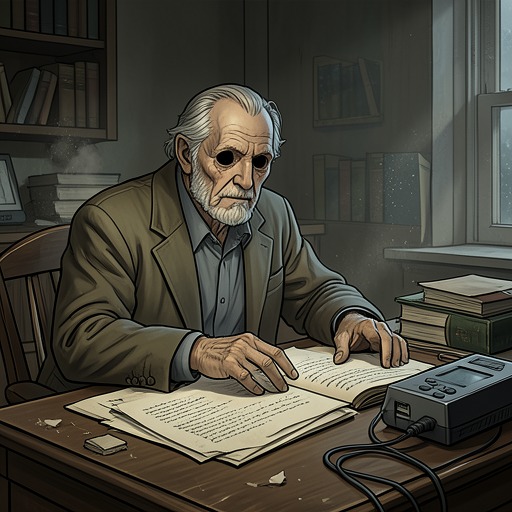
The manuscript’s material condition is inseparable from its meaning. Johnny describes reams of writing scattered across old napkins, the tattered edges of an envelope, and even the back of a postage stamp. The fragments are handwritten or typed, legible or illegible, lucid or impenetrable, torn, stained, taped, faded, burnt, folded, and refolded until creases have erased entire passages. Some are crossed out or amended; others branch into pieces encountered later. The result is not a stable sequence but an archive whose physical damage records the passage of years while also obstructing any final reconstruction of what those years contain: sense, truth, deceit, prophecy, lunacy, or nothing of the kind.
Discovery and Editorial Transmission
Johnny’s access to House of Leaves begins with Lude’s call and the removal of a black, paint-spattered trunk. The trunk is an old cedar-lined jobber built in Utica, New York, by the C. M. Clapp Company, with rusted latches and rotting leather handles. Its history is figured as a lifetime of digressions and disappointments, making the container a material counterpart to the manuscript inside it. The book does not arrive through an orderly literary channel; it is recovered from abandonment and carried forward by someone drawn to misplaced, forgotten, and vanishing things.
Three months after Lude’s call, Johnny has counted more than two hundred rejection letters from literary journals, publishing houses, and prominent professors at universities on the East Coast. No one wants the old man’s words except Johnny. That rejection establishes the unusual status of House of Leaves: it is not validated by institutions, yet Johnny assumes the labor of preserving and presenting it. His editorial role is therefore both an act of rescue and an act of selection. The book reaches readers through a chain of custodianship rather than through assured authority.
The title page makes this transmission explicit. Zampanò is named as the author, while Johnny is credited with the introduction and notes. The distinction appears formal, but the manuscript’s disorder repeatedly makes authorship difficult to separate from annotation, discovery, transcription, and interpretation. Johnny’s presence is not merely supplementary. His notes and framing determine how the recovered material can be approached, even as the manuscript’s gaps and contradictions prevent him from mastering it completely.
The Book Within the House Narrative
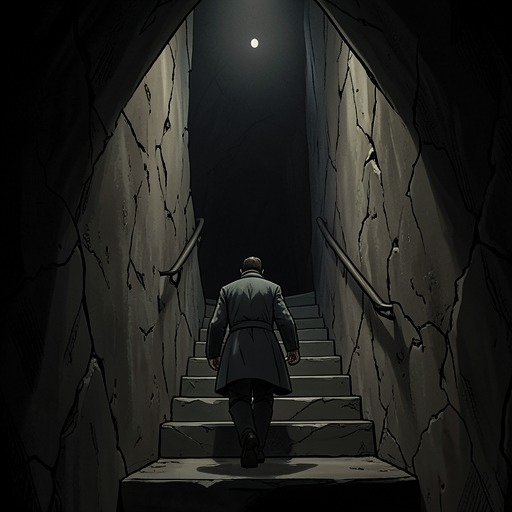
Within the recorded account of the Navidson house, House of Leaves also exists as an object in Will Navidson’s possession. When Navidson is disoriented in the darkness, suffering nausea and unable to determine whether he is floating, falling, rising, right side up, upside down, or on his side, he turns to the only remaining activity available to him: reading the only book he has with him, House of Leaves. The moment places the book inside the very spatial crisis that the book records, collapsing the distance between documentary subject and documentary artifact.
Navidson’s attempt to use the book as a resource is interrupted when the tape cuts off his statement about having only one book of matches and the duration of each match. Later examination of a black-and-white print magnifies the matchbook visible in the lower-left corner and identifies the words “Fuit Ilium” and “Thanks To These Puppies.” The episode joins the book to the limited technologies of survival available in the darkness: matches provide brief illumination, while the book provides a textual structure that may or may not remain usable when orientation itself has failed.
This embedded recurrence produces a sharp paradox. House of Leaves is the object Navidson reaches for when ordinary knowledge has become unreliable, yet the book’s own form is fragmented, interrupted, and resistant to definitive explanation. It promises orientation while reproducing disorientation. Reading does not remove the darkness; instead, it makes the darkness legible as a pattern of questions, pauses, missing passages, and competing accounts.
Narrative Structure and Uncertainty
The manuscript’s fragments repeatedly branch away from any single line of development. Words sometimes twist into meaning and sometimes into nothing; they break apart and lead toward other pieces that may appear later. This branching form rejects the expectation that a book should proceed from a secure beginning through an ordered middle toward a conclusive end. Any fragment may become a doorway into another fragment, and the reader must retain unresolved connections across physical and textual gaps.
The manuscript also makes its own status uncertain. Its layers of ink may preserve truth, deceit, prophecy, lunacy, or merely the residue of accumulated writing. The competing possibilities are not resolved by an authoritative explanatory voice. Instead, uncertainty is built into the material description of the object. The stains, burns, folds, and missing passages are not decorative signs of age; they are conditions that limit what can be known and force interpretation to operate without complete evidence.
That instability extends to the relation between text and reader. The book is repeatedly treated as something that can be found, handled, edited, rejected, recovered, and reread, rather than as a transparent container of facts. Its meaning emerges through acts of assembly: locating scattered pieces, comparing voices, judging legibility, and deciding whether apparent patterns are discoveries or projections. House of Leaves consequently turns reading into a form of exploration, one that resembles the movement through a space whose dimensions and entrances cannot be trusted.
Protection, Inheritance, and Significance
Johnny recognizes that people create stories to protect themselves, and House of Leaves embodies that protective function without reducing it to simple consolation. The book offers a structure through which horror can be approached indirectly, surrounded by introductions, notes, fragments, and editorial mediation. Yet the same protective layers can expose rather than conceal the wound, because every attempt to organize the material brings further uncertainty to the surface.
The book also becomes the medium of an uncertain inheritance. Lude does not need to possess the answer, or perhaps knows that he is not the one who can find it, while Johnny feels compelled to continue the search. Their friendship is linked to this division of labor: one person initiates the transmission, and the other accepts responsibility for an abandoned body of words. House of Leaves therefore passes between people not as a solved legacy but as an obligation whose meaning remains unsettled.
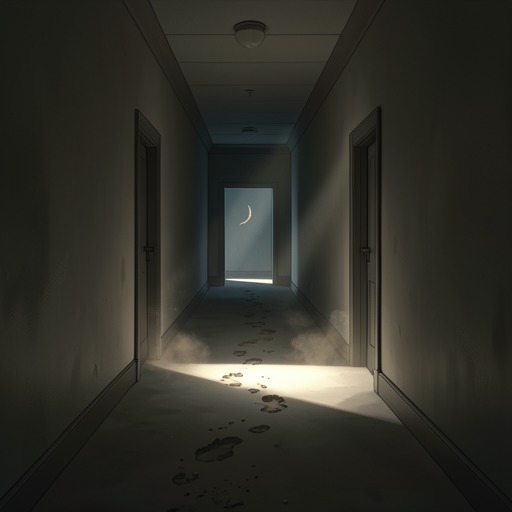
Its decisive literary role is to make form carry the same disturbance as content. The terrifying house is represented through a text that behaves like a damaged, expanding, internally connected space. The manuscript’s physical remnants, its disputed authorship, its appearance in Navidson’s darkness, and its later presentation by Johnny all make the book both evidence and enigma. House of Leaves does not simply tell readers what happened; it places them inside the conditions under which anything about what happened must be pieced together.